Active Transfer Learning for Efficient Video-Specific Human Pose Estimation

Toyota Technological Institute · WACV 2024
Pretrained VATL4Pose, 10% annotated

Drag the divider. The estimator on the right is adapted to this video with labels for 10% of the people in it.

Abstract

Human Pose (HP) estimation is actively researched because of its wide range of applications. However, even estimators pre-trained on large datasets may not perform satisfactorily due to a domain gap between the training and test data. To address this issue, we present our approach combining Active Learning (AL) and Transfer Learning (TL) to adapt HP estimators to individual video domains efficiently. For efficient learning, our approach quantifies (i) the estimation uncertainty based on the temporal changes in the estimated heatmaps and (ii) the unnaturalness in the estimated full-body HPs. These quantified criteria are then effectively combined with the state-of-the-art representativeness criterion to select uncertain and diverse samples for efficient HP estimator learning. Furthermore, we reconsider the existing Active Transfer Learning (ATL) method to introduce novel ideas related to the retraining methods and Stopping Criteria (SC). Experimental results demonstrate that our method enhances learning efficiency and outperforms comparative methods.
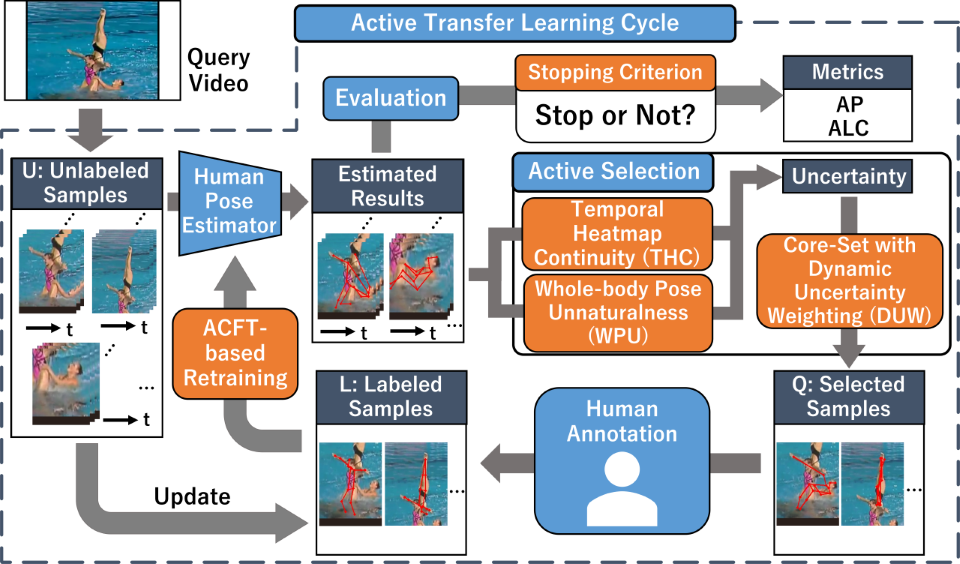
Overview of video-specific active transfer learning

Round by round

More results

Left: pretrained. Right: VATL4Pose with 10% of the people annotated.

Annotate your own video

One command runs the whole loop on a video of your own. SAMIDARE (CVsports 2026), a tracking-by-segmentation method for crowded scenes, detects and tracks the people. VATL4Pose then picks the people to annotate, a browser editor opens with the predicted keypoints, and the estimator is retrained after you save.

vatl4pose annotate my_video.mp4 --target-oks 0.8

After every round the tool shows the keypoints of everyone under the retrained estimator and asks whether to annotate another round. With --target-oks it also checks the stopping criterion of the paper, whether the estimator already reaches the target OKS on every person annotated so far, and proposes to finish once it does.

The first four rounds each ask for 5% of the people in the video, counting each person once per frame, and later rounds ask for 10 to 20%. On the 40-frame clip below, 277 people by this count, a round asked for 13 or 14, correcting one took about 35 seconds, and the results of a round appeared 14 to 52 seconds after Train on a GPU shared with another job. The 10% in the results above is two rounds.

The annotation tool: the editor with the predicted keypoints of one person, and the track of that person beside it

The editor shows the predicted keypoints of the selected person, and the video beside it plays the SAMIDARE track of that person. Clip from “Appalchian dancers at Rydale Folk Festival” by Wulyum, CC BY-SA 4.0, trimmed and resized; the screenshot is under the same license.

Video

Paper and poster

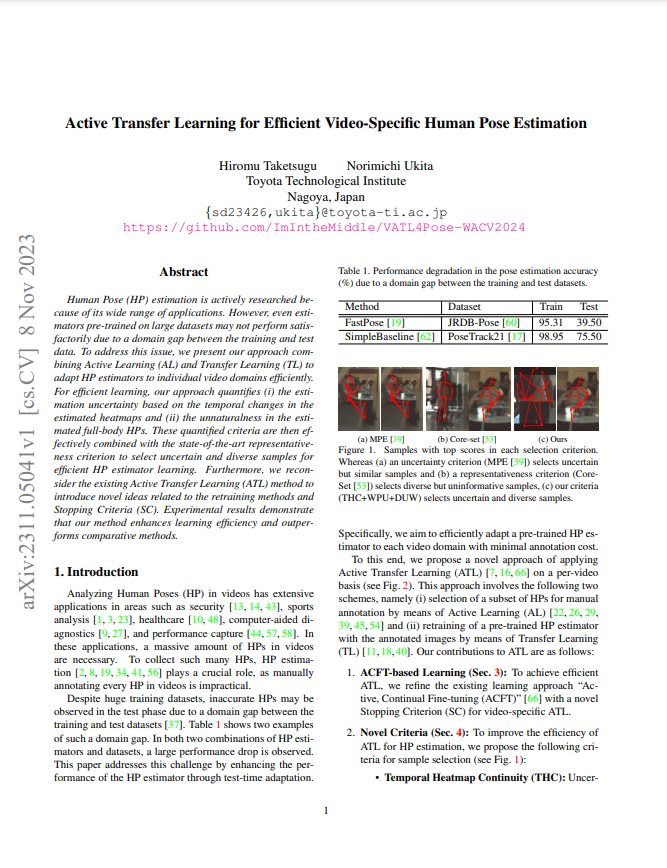
First page of the paper

Hiromu Taketsugu and Norimichi Ukita. Active Transfer Learning for Efficient Video-Specific Human Pose Estimation. WACV 2024, pp. 1880–1890.

Poster (PDF)

BibTeX

@InProceedings{VATL4Pose_WACV24,
  author    = {Taketsugu, Hiromu and Ukita, Norimichi},
  title     = {Active Transfer Learning for Efficient Video-Specific Human Pose Estimation},
  booktitle = {Proceedings of the IEEE/CVF Winter Conference on Applications of Computer Vision (WACV)},
  month     = {January},
  year      = {2024},
  pages     = {1880-1890}
}